


THE Most One-Word Slang not taught in German classes
- 12 minutes ago
- 6 min read
Let’s be completely real with each other: Classroom German is a lie.
Okay, maybe not a complete lie, but it’s definitely a heavily filtered, sanitized version of reality. You spend months memorizing case tables, practicing overly polite phrases like "Guten Tag, wie geht es Ihnen?", and convincing yourself that you’re ready to conquer Berlin, Vienna, or Zurich. Then you actually land in a German-speaking country, step into a café, sit on a train, or hang out at a house party, and suddenly... you have no idea what anyone is saying.
Why? Because native speakers don't talk like grammar textbooks. They don't use long, convoluted sentences when a single, punchy word can say it all. Real-world German—whether you’re in Germany, Austria, or Switzerland—is fueled by short, ultra-expressive, one-word slang.
If you want to stop sounding like a visiting diplomat and start sounding like a local who actually gets it, you’re in the right place. Let’s break down the ultimate one-word German
slang terms that your language teacher conveniently forgot to put in the curriculum.
Geil — The Ultimate Multi-Tool
Literal Translation: Horny (historically)
What it actually means: Awesome, cool, amazing
Yes, historically, this word meant something very NSFW, and if you say it to an 80-year-old grandma in Bavaria, she might still raise an eyebrow. But in modern, everyday slang? Geil is the undisputed king of praise.
Found a free pizza in the kitchen? Geil!
Got tickets to a sold-out concert? Geil!
It’s short, sharp, and carries an incredible amount of positive energy. If something is genuinely awesome, skip gut or wunderbar—just drop a solid Geil.

Hammer
Literal Translation: Hammer
What it actually means: Mind-blowing, phenomenal
When geil isn't quite strong enough to capture how awesome something is, you bring out the heavy machinery. Hammer works as an adjective, an exclamation, or a reaction to incredible news.
"Wie war die Party?" (How was the party?)
"Hammer!"
It’s punchy, satisfying to say, and instantly makes your enthusiasm feel authentic.

Krass
Literal Translation: Stark / Extreme
What it actually means: Wild, intense, crazy, sick
This is easily one of the most versatile words in the whole German language because it covers the entire emotional spectrum. Did someone just win the lottery? Krass! Did someone just accidentally drop their phone down a storm drain? Krass...
Whether a situation is amazingly good or shockingly bad, krass is your go-to reaction for anything that leaves you slightly speechless.

Pennen
Literal Translation: To crash / sleep
What it actually means: To sleep / to snooze
Textbooks will endlessly force-feed you the verb schlafen. And sure, schlafen is fine. But if you're telling your friends that you’re exhausted and heading to bed, or complaining that you only got three hours of sleep, drop the textbook term and use pennen.
"Ich gehe pennen." (I’m going to crash.)
It’s relaxed, cozy, and sounds infinitely more natural.

Quatschen
Literal Translation: To squish / slop
What it actually means: To chat, ramble, or talk nonsense
The official word for talking is sprechen, but who wants to sound like they’re giving a lecture? When you’re just hanging out with friends, drinking a coffee, and talking about absolutely nothing important, you are quatschen.
It implies a cozy, zero-pressure conversation where nobody is taking themselves too seriously.

Na?
Literal Translation: Well?
What it actually means: Hey! / What's up? / How are you?
If you only remember one word from this entire list, let it be this one. Na? is a masterpiece of linguistic efficiency. It is an entire greeting, check-in, and conversation starter packed into two letters.
Walk past a buddy in the street? Look them in the eye, give a quick head-nod, and drop a "Na?"
They’ll nod back, say "Na!", and keep walking. You’ve just had a full conversation in two syllables.

Prost!
Literal Translation: Cheers!
What it actually means: Bottoms up!
You’ll hear this word in German classes, but what they don't teach you is the strict etiquette around it. When you clink glasses and say Prost!, you must make direct eye contact with the person you’re clinking with. Break eye contact, and legend has it you’re cursed with seven years of bad luck in the bedroom. You’ve been warned.
Bock
Literal Translation: Male goat
What it actually means: Mood / Desire / Up for it
Forget Lust haben (having a desire for something). In the real world, it’s all about Bock.
"Bock?" (Up for it?)
"Bock!" (Hell yeah!)
"Null Bock." (Zero interest.)
It’s fast, casual, and instantly marks you as someone who knows how the language actually flows.

Alter
Literal Translation: Old one / Age
What it actually means: Bro, dude, man
Equivalent to the English "bro" or "man," Alter (often pronounced Aldaaaa) can be shoved into almost any sentence to add flavor, surprise, or annoyance.
"Alter, was machst du da?" (Dude, what are you doing?)
"Alter, das ist so geil!" (Bro, that’s so cool!)

Auf jeden Fall
Literal Translation: On every case
What it actually means: Definitely / 100% / Absolutely
Okay, fine—this one is technically three words, but in conversation, Germans run it together so fast it basically functions as a single, unstoppable block of agreement: Aufjedenfall!
When someone asks if you want to hang out or if you agree with something, skip a boring ja and throw down an energetic Auf jeden fall!

Kohle
Literal Translation: Coal
What it actually means: Cash / Dough / Moolah
Instead of Geld, native speakers love using Kohle.
"Hast du Kohle dabei?" (Got any cash on you?)
It’s casual, iconic, and dates back to the days when coal was the ultimate source of warmth and wealth.

Taking a Trip Across the Border: Austrian & Swiss Slang
If you think German slang stops at the German border, think again. Step into Austria or Switzerland, and the local vocabulary gets even more colorful.
The Austrian Flavor
Oida: The holy grail of Austrian slang. It literally means "old man," but in practice, it means everything. Depending on your tone of voice, Oida can mean "wow," "stop it," "are you kidding me?", "bro," "holy crap," or "I love you." Master the tone, master Vienna.
Leiwand: Pure Austrian praise. If something is leiwand, it’s brilliant, cool, or fantastic. It’s the Viennese equivalent of geil.

The Swiss Corner (One-Word Wonders)
Swiss German (Schwiizerdütsch) is practically its own language, but if you drop these one-word slang gems in Zurich or Basel, you’ll be an instant legend:
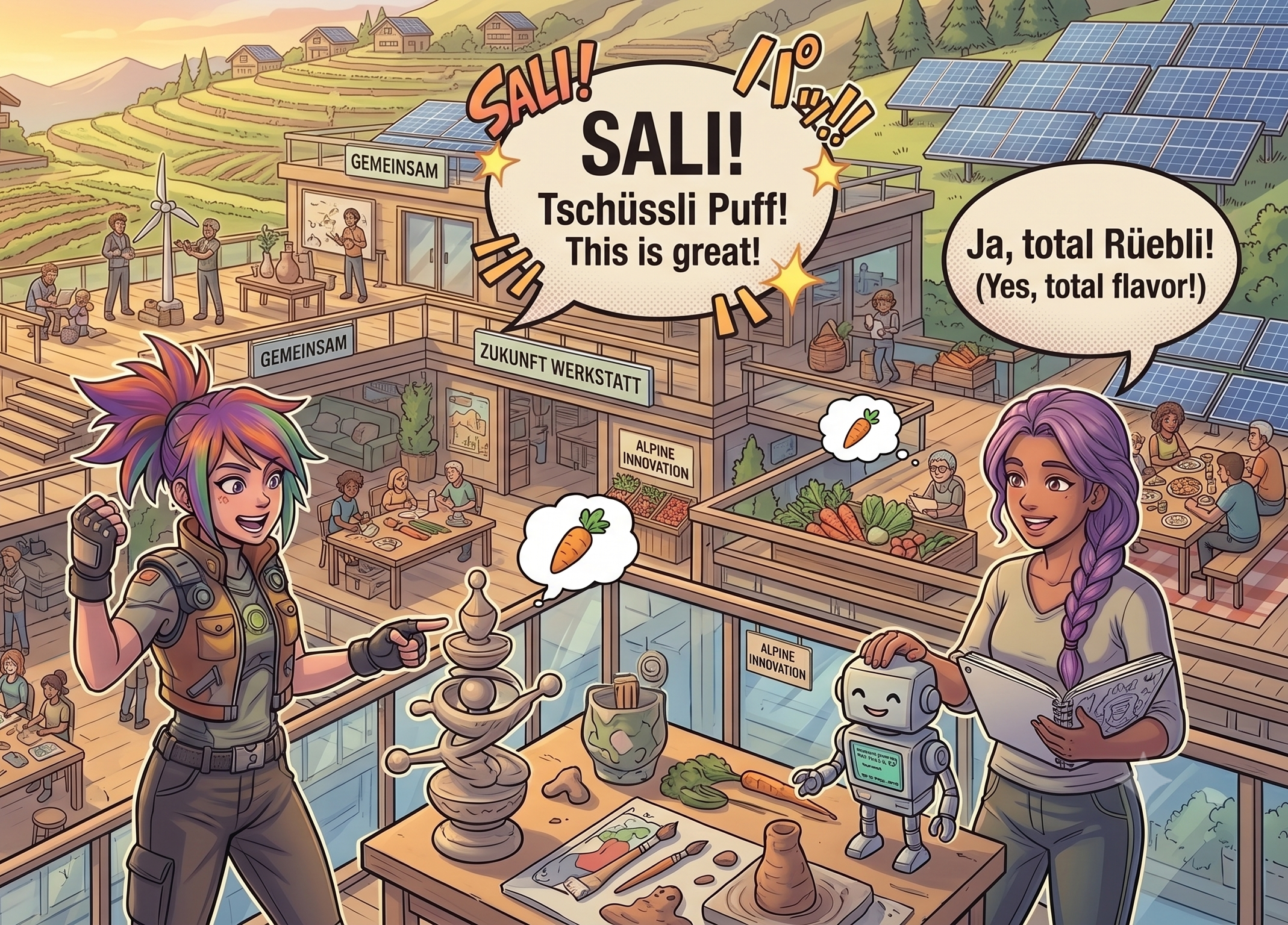
Sali: A super friendly, casual "Hello!" borrowed from the French Salut.
Tschüssli: The ultra-cute Swiss version of Tschüss (bye).
Rüebli: Technically means carrot, but used casually to describe someone from the canton of Aargau (or just used as cute local flavor).
Puff: Officially means chaos or a mess. If your room is messy or a situation is confusing, it’s a total Puff.
The Master Cheat Sheet
Slang Word | What it Actually Means | Best Used When... |
Geil | Awesome / Cool | Reacting to good news or great stuff. |
Hammer | Mind-blowing | Something is next-level awesome. |
Krass | Wild / Intense | Expressing shock, awe, or disbelief. |
Pennen | To crash / sleep | You’re exhausted and heading to bed. |
Quatschen | To chat / ramble | Hanging out and talking non-essential stuff. |
Na? | What's up? | Passing a friend in the street. |
Prost! | Cheers! | Clinking drinks (with direct eye contact!). |
Bock | Mood / Up for it | Checking if someone wants to do something. |
Alter | Dude / Bro | Adding emphasis, excitement, or frustration. |
Auf jeden Fall | Definitely! | Agreeing 100% with someone. |
Kohle | Cash / Money | Talking about finances casually. |
Oida (Austria) | Dude / Woah / Stop | Literally any emotion in Vienna. |
Leiwand (Austria) | Great / Awesome | High praise in Austria. |
Sali (Swiss) | Hey! | Casual Swiss greeting. |
Puff (Swiss) | Chaos / Mess | Describing a messy room or crazy situation. |
Ditch the Textbook, Join the Culture!
At the end of the day, learning a language isn't about passing a standardized test or getting a gold star from a teacher who hasn't stepped outside a classroom since 1998. It’s about connection.
When you use words like krass, bock, Oida, or hit someone with a smooth Na?, you bridge the gap between being a tourist and being a peer. You show native speakers that you don't just respect their language, you'll understand their vibe.
So, toss the dusty grammar rulebook aside for a second. Start weaving these one-word powerhouses into your daily practice, embrace the slight awkwardness of trying them out for the first time, and go have some real conversations. Auf jeden Fall, gib einfach Vollgas!


Comments