


10 Must Try Candies/Sweets under DACH Region (Germany, Switzerland, Austria)
The confectionery traditions of the DACH region, comprising Germany, Austria, and Switzerland, are deeply celebrated for their rich history, exquisite craftsmanship, and cultural significance. From the cozy coffee houses of Vienna to the bustling, historic bakeries of Hamburg and the pristine chocolatiers of Zurich, sweet treats play a central role in daily life and regional identity. In recent years, a massive wave of online search interest across social media platforms like Instagram and TikTok, as well as global search engines, has highlighted these traditional delicacies, introducing a new generation of travelers and food lovers to the delicious world of Central European sweets.
Understanding the landscape of these treats is a wonderful journey into German culture, Swiss culture, and Austrian culture. It reveals how centuries-old recipes, initially crafted for royalty or as festive holiday indulgences, have evolved into beloved everyday classics. For anyone exploring the culinary map of Central Europe, learning traditional German food names, Swiss food names, and Austrian food names is the first step toward uncovering these hidden gems.
Global Popularity and Search Trends of DACH Sweets
To determine the definitive ranking of these traditional sweets, data has been analyzed across search engines and social media platforms. The following table presents the 10 most highly recommended traditional candies and sweets in the DACH region, ranked by their current online search popularity and viral footprint.
Rank | Sweet Name | Country of Origin | Digital Search Dominance Platform | Est. Price Range (Local Retail) |
1 | Haribo Goldbears (Gummibären) | Germany | Google Search & Global Retail | €1.15 – €2.50 per bag |
2 | Ricola Swiss Herb Drops | Switzerland | Google Search & Wellness Forums | CHF 4.20 – CHF 5.95 |
3 | Apfelstrudel (Apple Strudel) | Austria | Instagram & Pinterest Trends | €4.00 – €10.00 per slice |
4 | Werther's Original | Germany | YouTube Nostalgia & Review Blogs | €1.50 – €3.00 per pack |
5 | Mozartkugeln (Mozart Balls) | Austria | Google Search & Travel Vlogs | €8.99 – €12.99 per bag/box |
6 | Lübecker Marzipan (Niederegger) | Germany | Google Shopping & Festive Forums | €4.29 – €19.99 |
7 | Luxemburgerli (Sprüngli) | Switzerland | Instagram & TikTok Visuals | CHF 22.90 – CHF 59.90 |
8 | Basler Läckerli | Switzerland | Christmas Market Search Trends | CHF 14.90 – CHF 19.95 |
9 | Ahoj-Brause (Fizzy Candy) | Germany | TikTok Retro & Mukbang Trends | €1.00 – €2.00 per pack |
10 | Nussecken (Nut Corners) | Germany | Recipe Blogs & YouTube Baking | €1.50 – €3.00 per piece |
Exploring the 10 Must-Try Sweets and Candies
1. Haribo Goldbears (Gummibären) — Germany

As an undisputed giant of global candy search volume, the humble gummy bear sits at the pinnacle of confectionery interest. Deeply rooted in German culture, these fruit-flavored gelatin treats were first invented in 1922 near Bonn by the visionary confectioner Hans Riegel. The name "Haribo" is a clever acronym of the founder’s name and birthplace: Hans Riegel Bonn.
Their global popularity stems from a brilliant combination of nostalgic texture and distinct fruit flavors. Authentic German-market Goldbears feature six classic varieties, utilizing natural fruit concentrates: white (pineapple), green (apple), yellow (lemon), orange (orange), light red (strawberry), and dark red (raspberry). In German food names, these are affectionately referred to as Gummibären or Goldbären.
While Haribo is distributed globally, confectionery enthusiasts frequently note that the original German recipe, which relies strictly on natural colorings and a firmer texture, remains highly superior to international variants. This culinary distinction keeps domestic search volumes exceptionally high as consumers seek out imported German versions. It is widely celebrated as some of the best German food for casual snacking.
Where Sold Most: Supermarkets across Germany, specialized Haribo outlet stores, and international import shops.
Current Price Range: Standard 175g–200g bags typically retail between €1.15 and €2.50 in local German supermarkets.
2. Ricola Swiss Herb Drops — Switzerland

Representing a cornerstone of Swiss culture, Ricola is one of the most recognized non-chocolate Swiss food names in the world. Its online popularity is driven by its unique dual identity as both a comforting candy and a functional wellness product. The original recipe, created by company founder Emil Richterich in Laufen, dates back to a meticulously balanced blend of 13 alpine herbs.
What sets Ricola apart is the company's commitment to sustainability and authentic agricultural heritage. The brand partners exclusively with local Swiss farmers who cultivate these mountain herbs without pesticides or herbicides. This natural purity appeals directly to health-conscious consumers, elevating Ricola above typical sugary lozenges. It is regarded by culinary experts as the best Swiss food in the herbal confectionery category.
In digital spaces, Ricola enjoys high search volumes during winter seasons, but it remains a year-round travel essential. The Swiss-market editions, which feature exclusive flavors like Elderflower and Alpine Mint, are highly sought after by global shoppers.
Where Sold Most: Swiss supermarkets (such as Coop), global pharmacies, airport duty-free shops, and convenience stores.
Current Price Range: Traditional 100g double-packs retail for CHF 4.20 to CHF 5.95 in Switzerland, while travel tins at airports average €5.49 to €5.99.
3. Apfelstrudel (Apple Strudel) — Austria
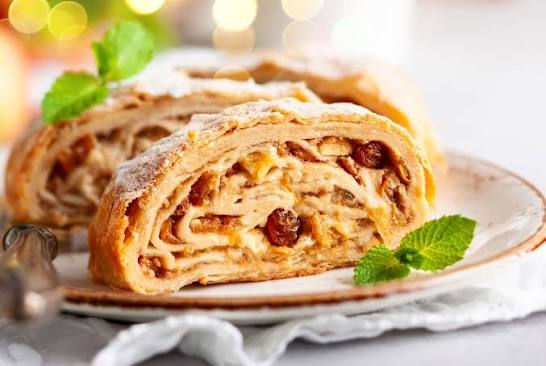
While technically classified as a pastry, the legendary Apfelstrudel is universally sought after as a traditional sweet dessert, earning a permanent place on lists of the best Austrian food. The dish represents a masterclass in culinary patience, with its historical birthplace in Austria documented as early as a handwritten recipe from 1697.
The uniqueness of an authentic Austrian strudel lies in its paper-thin, hand-stretched unleavened dough. Traditional bakers roll and stretch the flour-and-water dough by hand until it becomes transparent enough to "read a newspaper through". This ultra-thin shell encases a warm, spiced filling of tart baking apples, dark raisins, cinnamon, sugar, and butter-toasted breadcrumbs.
Globally, the search interest for Apfelstrudel spikes during autumn and winter, evoking images of cozy alpine retreats and Viennese coffeehouses. It remains a sensory symbol of Austrian culture, frequently enjoyed alongside a warm cup of Wiener Melange. It is frequently ranked among the best Austrian food for dessert lovers.
Where Sold Most: Traditional Viennese coffeehouses, bakeries, and alpine ski resorts throughout Austria.
Current Price Range: Slices in local Viennese neighborhood bakeries cost €4.00 to €6.00, whereas historic, tourist-frequented locations such as Café Central or Café Demel charge €6.00 to €10.00.
4. Werther's Original — Germany

Originally marketed under the German food names Werther's Echte, this iconic butter-cream hard candy has been a global favorite since its creation in 1909. Invented by the confectioner Gustav Nebel in the small Westphalian town of Werther, the candy was formulated to capture the simple, rich flavors of home baking.
The recipe utilizes premium ingredients, including real butter, fresh cream, and white and brown sugars, cooked slowly to achieve a velvety, slow-melting caramel finish. The brand's online search popularity remains remarkably stable, fueled by cross-generational nostalgia and widespread availability in over a hundred countries. Werther's represents a masterclass in brand continuity, maintaining its warm, golden aesthetic and rich flavor profile across more than a century of production.
Where Sold Most: Supermarkets and retail chains globally, with specialized varieties available in Germany.
Current Price Range: A standard bag costs between €1.50 and €3.00 in European retail stores.
5. Mozartkugeln (Mozart Balls) — Austria

The Mozartkugel is widely recognized as the most famous chocolate-based sweet from Austria, acting as a highly searched souvenir and a symbol of Salzburg’s artistic heritage. First conceived in 1890 by Salzburg master confectioner Paul Fürst, the treat was named in honor of the city’s iconic composer, Wolfgang Amadeus Mozart.
The architectural complexity of a Mozartkugel is its defining characteristic: a core of green pistachio marzipan is wrapped in a layer of rich, sweet nougat, and finally enrobed in high-quality dark chocolate. While the Fürst family continues to manufacture the "Original Salzburger Mozartkugeln" by hand using the traditional stick-dipping method, other confectioners like Mirabell and Reber industrially produce them. Due to historical legal disputes, only Mirabell is permitted to produce perfectly round Mozartkugeln; all other commercial versions must feature one slightly flat side. Classic Austrian food names like this represent the absolute peak of gifting during travels.
Where Sold Most: Confectioneries and souvenir boutiques in Salzburg and Vienna.
Current Price Range: Standard supermarket bags of 15–16 pieces (by Victor Schmidt or Mirabell) range from €8.99 to €9.99, while artisanal handmade boxes or large premium assortments can cost between €19.99 and €79.99.
6. Lübecker Marzipan (Niederegger) — Germany

Marzipan is deeply woven into the fabric of German culture, and the northern city of Lübeck is celebrated as its historical capital. Founded in 1806 by Johann Georg Niederegger, the company Niederegger revolutionized marzipan production by setting a standard of 100% pure almond paste, avoiding the heavy sugar dilution practiced by competitors.
In German food names, Lübecker Marzipan is protected by EU law as a Geographical Indication, ensuring that the product must be manufactured in or around Lübeck. Traditional Niederegger marzipan is prized for its high almond oil content, sweet aroma, and delicate coating of dark chocolate, which cuts through the richness of the nut paste. Online search interest peaks heavily during the Christmas and Easter holidays, when marzipan is molded into festive figures and given as traditional gifts.
Where Sold Most: Café Niederegger in Lübeck, specialized department stores, and supermarkets throughout Germany.
Current Price Range: Small marzipan loaves retail for €4.29 to €6.89, while elegant 300g gift assortments range from €14.95 to €19.99.
7. Luxemburgerli (Sprüngli) — Switzerland

While France is famous for its macarons, Switzerland has its own lighter, airier, and highly sought-after counterpart: the Luxemburgerli. Created in 1957 by a young Luxembourgish confectioner at the legendary Confiserie Sprüngli in Zurich, these bite-sized gems have become a modern icon of Swiss culture.
Luxemburgerli are significantly smaller and fluffier than traditional French macarons, designed to be consumed in a single, delicate bite. They consist of two light meringue shells sandwiching a velvety cream filling, available in classic flavors like Bourbon-Vanilla, Caramel Fleur de Sel, and Champagne Rosé. Their elegant appearance has earned them a massive digital footprint, particularly on highly visual social media platforms, transforming a regional delicacy into a symbol of luxury travel in Zurich. It is widely celebrated as some of the best Swiss food to enjoy with coffee.
Where Sold Most: Exclusively at Confiserie Sprüngli boutiques in Zurich and major Swiss travel hubs.
Current Price Range: Premium gift boxes containing 16 pieces cost approximately CHF 29.90, while larger presentation trays of 36 pieces retail for around CHF 57.90 to CHF 59.90.
8. Basler Läckerli — Switzerland

Originating in the historic city of Basel, the Basler Läckerli is a dense, spiced glaze biscuit sweet that has delighted palates for some 600 to 700 years. Originally created by local spice merchants to sustain ecclesiastical members of the Basel Council, this unique sweet is deeply embedded in Swiss culture.
The recipe combines warmed honey, chopped almonds, hazelnuts, candied orange and lemon peel, a rich blend of baking spices, and a splash of cherry brandy (Kirsch). While the flat baked dough is still hot, bakers spread a thin glaze of sugar over the surface and slice the sheet into small rectangular bars. The result is a hard, chewy confection with a sweet, aromatic flavor profile. Search interest spikes dramatically during the autumn and winter holidays, as these treats are synonymous with cozy winter gatherings.
Where Sold Most: Specialized confectioneries in Basel, supermarkets across Switzerland (such as Migros and Coop), and traditional European Christmas markets.
Current Price Range: Standard bags typically retail between CHF 14.90 and CHF 19.90 depending on the package size.
9. Ahoj-Brause (Fizzy Candy) — Germany

For generations of children and adults raised in Germany, Ahoj-Brause is synonymous with pure, fizzy nostalgia. Introduced in the 1920s as an effervescent powdered drink mix, the brand has expanded into highly sought-after soft gummies, chewable tablets, and rectangular candy blocks.
The defining characteristic of Ahoj-Brause is the tingling, sour effervescence that explodes on the tongue, achieved through a blend of sodium bicarbonate and tartaric acid. The candy is most famous for its woodruff (Waldmeister) flavor—a sweet, herbal, and distinctively green profile that is incredibly unique to German culture. Online search trends remain high due to retro candy challenges, viral mukbang videos, and creative cocktail recipes where adults mix the sweet powder with spirits.
Where Sold Most: Supermarkets, candy stalls, and convenience kiosks all over Germany.
Current Price Range: Standard packets of fizzy powder or bags of soft gummy candies cost between €1.00 and €2.00, making it an incredibly affordable, fun treat.
10. Nussecken (Nut Corners) — Germany

Often considered some of the best German food for travelers with a sweet tooth, Nussecken are a beloved bakery staple year-round, with searches spiking during the festive autumn and Christmas market seasons.
A traditional Nussecke is built in distinct, delicious layers. It features a tender, buttery shortbread base, spread with a thin layer of sweet, tart apricot jam. This is topped with a thick, caramelized crust of butter, sugar, and toasted hazelnuts (or a blend of almonds and hazelnuts to balance the rich texture). Once baked and cooled, the slab is cut into triangles, and the sharp corners are dipped in rich, dark chocolate. The resulting contrast of crumbly shortbread, gooey jam, crunchy caramelized nuts, and smooth chocolate creates a unique sensory experience.
Where Sold Most: Standalone neighborhood bakeries and Christmas markets across Germany.
Current Price Range: A single, bakery-sized piece typically ranges from €1.50 to €3.00, making it an affordable and highly satisfying everyday treat.
Traditional DACH Sweets Comparison
To help navigate these incredible regional specialties, the following table summarizes the key attributes of the top sweets, highlighting their flavor profiles, textural qualities, and ideal serving companions.
Sweet Name | Core Textural Quality | Main Spices / Aromatics Used | Classic Beverage Pairing | Best Season to Enjoy |
Haribo Goldbears | Firm, Chewy | Natural Fruit Extracts | Sparkling Water | Year-Round |
Ricola Drops | Hard-boiled, Smooth | Mint, Eucalyptus, Thyme | Herbal Tea | Winter & Autumn |
Apfelstrudel | Flaky, Soft, Crisp | Cinnamon, Lemon Zest | Wiener Melange | Autumn & Winter |
Werther's Original | Smooth, Slow-Melting | Rich Butter, Cream, Molasses | Filter Coffee | Year-Round |
Mozartkugeln | Soft, Layered, Velvety | Pistachio, Almond, Marzipan | Espresso | Year-Round |
Lübecker Marzipan | Dense, Rich, Melting | Roasted Almond, Dark Cocoa | Black Tea | Christmas & Easter |
Luxemburgerli | Light, Airy, Creamy | Champagne, Vanilla, Pistachio | Cappuccino | Year-Round |
Basler Läckerli | Hard, Chewy, Glazed | Honey, Clove, Cinnamon, Kirsch | Espresso | Autumn & Winter |
Ahoj-Brause | Fizzy, Soft, Powdery | Woodruff (Waldmeister), Lemon | Cold Water / Tonic | Summer & Spring |
Nussecken | Crumbly, Gooey, Crunchy | Toasted Hazelnut, Apricot | Cafe Latte | Year-Round |
Concluding Thoughts
Exploring the diverse and deeply satisfying confectionery map of the DACH region shows how sweets are woven directly into the daily lifestyle and historic celebrations of Germany, Austria, and Switzerland. Whether seeking out the finest artisanal chocolate creations, buying historical souvenirs to bring home to loved ones, or simply stopping at a warm corner bakery for a midday treat, these sweets offer a delightful window into the hearts of these three beautiful countries. Armed with this guide to the region's most highly searched and beloved treats, anyone can confidently dive into the sweet culinary wonders of Central Europe.


Comments