


Self-Development with German, how do you become better yourself?
Let’s be completely honest for a second. Whenever someone mentions they are studying German, the collective response is usually a mix of awe and mild pity. We’ve all heard the rumors: the endless compound words, the terrifying case system, and that lingering myth that German is hard😒, so hard that it’s borderline impossible to master unless you’re born wearing lederhosen.
But what if I told you that hacking your way through this beautiful, architectural language is actually the ultimate self-improvement masterclass?
When you set out to learn German efficiently, you aren't just memorizing vocabulary to order a Bier or a Brezel. You are literally rewriting your brain’s cognitive software. There is a famous quote by Charlemagne that goes, "To have another language is to possess a second soul." If that language is German, that second soul is highly organized, incredibly focused, deeply patient, and remarkably precise.
We often hear the stereotype that Germans are efficient. Well, guess what?
The efficiency isn't just a cultural trait; it’s baked directly into the DNA of the grammar.
If you want to learn German easy and fast while unlocking an upgraded version of yourself, you have to look at how the language shapes your mind.
Let’s dive into the five major self-development qualities you naturally build within yourself when you learn to speak like a local.

1. Punctuality
If you struggle with time management, German grammar is about to become your new best friend.
In English, we are pretty casual with where we drop our time phrases. You can say,
"I am going to the store tomorrow,"
or
"Tomorrow, I am going to the store,"
or even
"I am, tomorrow, going to the store" (if you want to sound poetic).
German looks at that flexibility and says, "NEIN, NEIN, NEIN!."

Main Clause Word Order:
Position 1: [Topic/Time] -> Position 2: [Conjugated Verb] -> Position 3: [Subject/Pronoun]

or

Position 1:[Subject/Pronoun] -> Position 2: [Conjugated Verb] -> Position 3: [Topic/Time]
In standard German sentence structure, the conjugated verb is fiercely protective of Position 2. Because of this, time elements are highly prioritized. If you want to build a proper German sentence using the classic TeKaMoLo rule (Temporal, Causal, Modal, Local), Time always comes first in the modifier train.
More specifically, time phrases are strictly locked into either Position 1 or Position 3. For example:
Heute gehe ich in den Park. (Today go I into the park. - Time is in 1st position)
Ich gehe heute in den Park. (I go today into the park. - Time is in 3rd position)

The Self-Development Shift:
Constantly calculating exactly when an action occurs before you even finish forming a sentence trains your brain to treat time as a structural priority.
You cannot afford to treat time as an afterthought in German syntax, and naturally, that mental habit spills over into real life.
You start viewing your daily schedule with the same rigid structure.
Before you know it, you're arriving at meetings five minutes early, perfectly exemplifying the legendary German punctuality.
2. Radical Precision
We live in a world where communication is often messy. We text in half-thoughts and leave things vague. German grammar, however, demands absolute clarity. It forces you to be incredibly specific about who is doing what to whom.
Two specific grammatical features will supercharge your personal precision:
The Reflexive Focus
German relies heavily on reflexive verbs (reflexive Verben), which require you to state explicitly that you are performing an action upon yourself. You don’t just "hurry up"; you hurry yourself (ich beeile mich). You don’t just "imagine" something; you imagine it to yourself (ich stelle mir vor).
The Triad of "You"
In modern English, we use the word "you" for everyone. It doesn't matter if you're talking to your cat, your boss, your spouse, or a stadium filled with 50,000 strangers. It’s just "you." German looks at this and demands sociological accuracy. To get your point across, you must choose between three completely different tracks:
Du: Singular, informal (friends, family, children).
Ihr: Plural, informal (a group of your buddies).
Sie: Singular and plural, formal (bosses, strangers, authority figures).
English | German Target | Relationship Context |
You | Du | Close friend, family member, child |
You (all) | Ihr | Co-workers at a casual lunch, a group of peers |
You (formal) | Sie | A bank teller, your CEO, a stranger on the street |

The Self-Development Shift:
Navigating these rules forces you to develop deep emotional intelligence and situational awareness.
You have to constantly evaluate your relationship boundaries with others before you open your mouth.
This builds a keen sense of social precision and mindfulness, turning you into a highly articulate communicator who knows exactly how to read a room.
3. High Adaptability
To learn German like natives do, you have to get comfortable with the concept of structural shape-shifting. Enter the world of prefixes, specifically separable (trennbar) and inseparable (untrennbar) verbs—a concept I like to call the 3R Rhythm: Reduce, Reuse, and Recycle.
In German, a base verb like stehen (to stand) can completely mutate its meaning depending on the tiny prefix attached to it. Rather than inventing entirely new words for every action, German reduces vocabulary overload by meticulously reusing these basic verb stems. It's a marvel of linguistic recycling.
Add ver- and it becomes verstehen (to understand - inseparable).
Add auf- and it becomes aufstehen (to stand up - separable).
What makes separable verbs a wild mental workout is that when you conjugate them in a regular sentence, the prefix detaches and flies all the way to the very end of the sentence like a boomerang.
Ich stehe jeden Morgen um sechs Uhr gut gelaunt auf. (I stand every morning at six o'clock in a good mood up.)

The Self-Development Shift:
This "3R" mindset (Reduce, Reuse, Recycle) of German grammar trains your brain to seek the most efficient path.
Instead of over-complicating, you learn to reduce unnecessary mental clatter and focus on core components.
You see how a few well-chosen pieces (base verbs and prefixes) can be reused and recycled to create endless meaning.
This cognitive flexibility directly translates to real-world adaptability, as it encourages you to look for ingenious alternatives and reusable solutions, ultimately saving you time and energy.
4. Next-Level Patience
If you are a naturally impatient person who constantly interrupts people, German is the ultimate reality check. The language practically weaponizes patience through its strict verb placement rules.
In a standard German main clause, the conjugated verb sits comfortably in the second position. But the moment you introduce a subordinating conjunction or a subjunctive connector, words like weil (because), dass (that), wenn (if/when), or obwohl (although), the grammar rules trigger the V2-VLast rule. This rule forcefully ejects the conjugated verb from the front of the clause and banishes it to the absolute end.
Consider this sentence:
"Ich kann heute nicht zu deiner Party kommen, weil ich gestern mein ganzes Geld für teure deutsche Grammatikbücher ausgegeben habe."
(I can today not to your party come, because I yesterday all my money on expensive German grammar books spent have.)
Because of this structure, you literally cannot understand the core action of what someone is saying until they speak the final syllable of their sentence. If you interrupt them three words before the end, you miss the punchline of the entire thought.
[Subordinating Connector] --> (Context, Details, Modifiers) --> [CONJUGATED VERB AT THE VERY END]
                                                                        ^
                                                                 Must wait until here!

The Self-Development Shift:
Linguistic studies heavily back up the idea that syntax alters our real-world behavior.
A famous body of research by cognitive psychologist Lera Boroditsky demonstrates that the structural features of a language profoundly shape how its speakers process reality, pay attention, and exhibit self-control.
By forcing yourself to wait for the final verb, you naturally cultivate deep listening skills and profound patience. You stop preparing your response while the other person is still talking, simply because you don't have all the data yet!
5. Absolute Completion
Have you ever started a project, gotten bored halfway through, and left it completely unfinished? German grammar has a built-in cure for that, and it lies within the past tense (Perfekt) and compound verb systems.
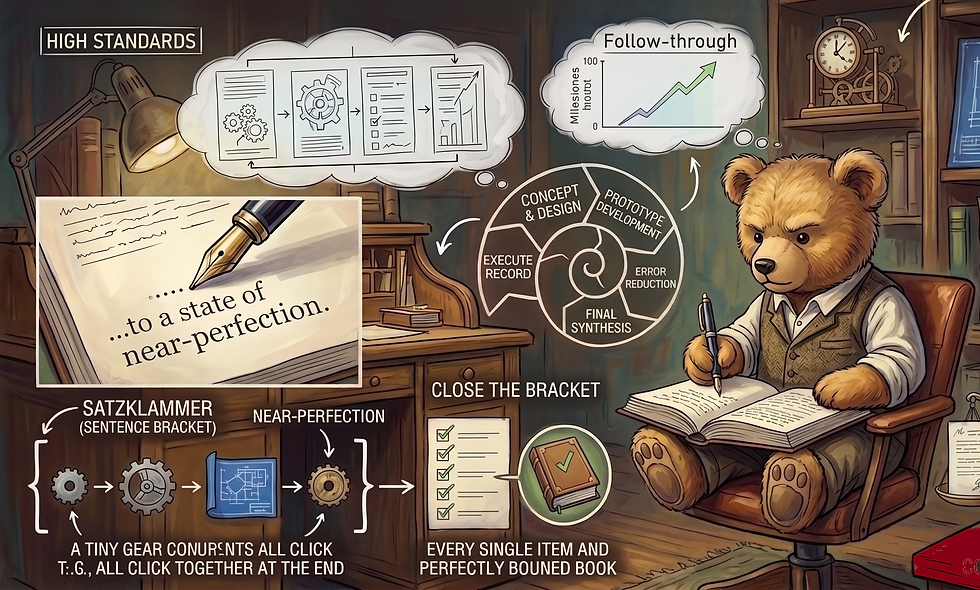
In German, when you express a past action, you create what linguists call a Satzklammer (a sentence bracket or frame). You place your auxiliary verb (haben or sein) in the second position, and you drop the past participle (the action word, usually starting with ge-) at the absolute end.
Until that final past participle is dropped into place, the sentence is fundamentally broken and incomplete. You cannot just stop mid-sentence; you are structurally obligated to bring the thought to a state of near-perfection and completion.
Ich habe das anstrengende Projekt endlich abgeschlossen. (I have the exhausting project finally completed.)
The Primary Data Connection:
This isn't just a quirky grammar rule; it genuinely changes how you view tasks. A fascinating primary research study published in the journal Psychological Science (Athanasopoulos et al., 2015) looked at how bilingual English and German speakers perceive actions.
The researchers found that German speakers are inherently more goal-oriented and completion-focused than English speakers. When shown a video of a person walking, English speakers typically describe the ongoing action ("a woman is walking"), whereas German speakers focus heavily on the end goal and completion of the action ("a woman walks towards her car").
 LINGUISTIC FOCUS STUDY (Athanasopoulos et al.)
 ┌───────────────────────────────────────────────┐
 │ English Speakers: Focus on the ongoing action │
 ├───────────────────────────────────────────────┤
 │ German Speakers: Focus on the ultimate GOAL   │
 └───────────────────────────────────────────────┘
The Self-Development Shift:
By training yourself to close the grammatical bracket every time you speak, you are subconsciously training your brain to follow through on your real-world goals.
You develop a high-standard, near-perfectionist drive to see tasks through to the finish line. "Alles in Ordnung" isn't just a thing you say if everything is okay; it becomes your natural default setting, in the sense of "Everything is in order".
So, is German hard? Sure, it presents a unique challenge at first. But when you reframe it as a tool for personal evolution, every declension table and word-order rule becomes a stepping stone toward a more disciplined, precise, and patient version of yourself. The Foreign Service Institute (FSI) classifies German as a Category II language, meaning it takes slightly more conscious effort to master than languages like Spanish or French.
But that extra effort is exactly where the self-development magic happens.
When you practice German, you aren't just learning a language; you are building an internal framework of peak efficiency, unflappable patience, and radical attention to detail.
Embrace the sentence brackets, learn to love waiting for the final verb, and give your time phrases the priority they deserve. By choosing to step up to the plate and speak this beautifully structured language, you aren't just gaining a new linguistic skill—you are actively engineering a better version of yourself. Viel Erfolg auf deiner Reise!


Comments