


HOW TO RUIN YOUR LIFE LEARNING GERMAN!
Look around international job boards or migration forums, and you will see an identical narrative. You are told there is an abundance of opportunities in Germany. You hear endless promises regarding high-paying jobs in Germany and unparalleled career stability with lucrative jobs in Switzerland. The propaganda machine frames the DACH region as an "The Land of Opportunities" waiting for individuals to claim their stake.
But there is a reason you rarely hear the unvarnished truth: human psychology naturally repels discomfort. If influencers told you the brutal reality of professional fluency, you would look at the friction and convince yourself not to try. You would avoid the path altogether to save your ego. This article is written without standard marketing sugarcoating to explicitly map out the systematic potholes, cognitive traps, and strategic blunders that thousands of learners fall into every year when trying to master the German language.

1. Learning Randomly from Apps and Social Media
If you want to ensure complete structural incompetence, your best strategy is to rely entirely on language learning applications, short-form algorithm feeds, and detached YouTube videos. Many who search for how to learn German mistake an app streak for genuine linguistic competence. They believe that matching cartoon vocabulary cards or watching a 60-second video on idioms equates to functional literacy.
This approach lacks a coherent systematic framework. It treats a highly complex, heavily structured language as a casual game.
You cannot build a rigorous grammatical foundation through fragmented, contextless flashcards.
When you learn randomly, you miss the structural macro-architecture of the language, such as case endings, adjective declensions, and subordinating clause word order.
You are left with a superficial vocabulary and zero ability to synthesize a professional sentence, effectively automating your procrastination while convincing yourself you are studying.
Out of 250+ students thought thus far, more than half of them learned German previously on their own and they just ended up speaking German in their own 'interpretation'.
For example, let's say this sentence here:
(i) Someone who learned German properly, who have learned systematically the basic verbs, will say both in writing and verbally the German words in correct order:
Wenn er zum Wandern gegangen ist, hat er ein bisschen Wasser getrunken.
(literal translation: When he for hiking gone have, have he a little bit of Water drank.)
This one here is said by a student who have learned the German grammar of the "V2-VLast" concept of German sentence as well as the German's second connector type called "Subjunction", and not just he or she has learned it, but also he or she has practiced using it.
(ii) Compared to someone who learned German with random verbs, nouns and grammars.
Wenn er ist gegangen zum Wandern, er hat getrunken ein bisschen Wasser.
(literal translation: When he go for a hiking, he have drank a little bit Water.)
It may seem right as you are just translating one-to-one in English. And as long as they can say the words, then it's considered they really saying what they are trying to say in English or their native language, but really this is what they are saying if translated.

2. High Fees Language Institute for Zero Application
On the opposite end of the spectrum lies the institutional trap. Many learners believe that spending massive amounts of money at prestigious language institutes guarantees fluency. They enroll in intensive courses where they sit in a crowded room of fifteen students for a few hours.
I mean just look at the prices for each of these courses offered in all these language institutes:
Region / Institute | Estimated Price (Per Level: A1 or A2) | Average Duration (Per Level) | Content Taught | Style of Teaching |
Goethe-Institut Germany | ~€400 – €1,200+ (Highly dependent on city and intensive vs. online format) | 4 to 8 weeks (Intensive: 75–80 units of 45 mins) | Standard CEFR curriculum; focus on everyday life, reading, writing, listening, and essential grammar. | Immersive but Crowded: Highly structured and utilizes premium native resources. However, group sizes restrict individual active speaking time to just a few minutes per class. |
Goethe-Institut Malaysia | ~RM 8,000 (Based on standard local group course rates) | 8 to 12 weeks (Standard tracking) | Standard CEFR curriculum; test preparation for the Goethe-Zertifikat. | The "Expat Bubble": Focuses heavily on academic textbook mastery. Students study in a localized bubble and immediately switch back to their native language the moment they walk out the door. |
Goethe-Institut Thailand | ~9,200 – 10,900 THB ($279 USD) | 4 to 10 weeks (Super-intensive vs. standard) | Standard CEFR foundational German; basic vocabulary, text comprehension, and audio drills. | Passive Processing: Max 16 students per class. A significant portion of the session involves listening to other non-native students struggle through basic texts or grammar exercises. |
Goethe-Institut India (Max Mueller Bhavan - Cheapest Famous Branch) | ~₹28,500 INR (~€320 / $340 USD) | 5 to 11 weeks (Super-intensive to standard intensive tracking) | Rigid CEFR curriculum; exhaustive focus on textbook exercises (e.g., Netzwerk Neu) and certificate exam structures. | The Rote-Learning Factory: Outstanding value on paper, making it the cheapest famous option globally. However, classes host up to 18–22 students. Active individual output is nearly non-existent; learning is heavily passive and exam-centric. |
In this environment, your active speaking time is restricted to a precious few minutes per session. The rest of the time is spent listening to fellow non-natives struggle through basic texts.
The tragedy of this approach is the complete lack of post-classroom application. Students leave the institute, immediately switch back to their native language, and refuse to engage with the real world outside.
They pay a premium for the comforting illusion of structure, yet they fail to actively apply the language under real-world pressure.
If you do not force yourself to use the language outside of those institutional walls, you are simply spending at an expensive social club.
3. The Academic Blunder: Pursuing a Bachelor's Degree in German Studies
Investing years to obtain a Bachelor's degree in Germanic Studies is a highly inefficient professional strategy.
If your ultimate objective is to secure high-tier jobs or find competitive corporate roles, an undergraduate degree in the language itself renders you practically unemployable compared to technical specialists who holds Master or PHD from a English-taught postgraduate programs. You will graduate knowing how to analyze centuries-old literature, but still you are not considered the top-talent they are looking for.
And so, the logical alternative is glaringly obvious: you might as well pursue a specialized Master’s degree in engineering, tech, finance, or business administration taught entirely in English.
This strategy allows you to build concrete, highly sought-after expertise while concurrently treating the German language as a parallel utility tool. The European market does not pay a premium merely because you can speak German; it pays a premium when you can solve complex technical problems and communicate those solutions effectively. Do not confuse a linguistic tool with a professional qualification.

4. The Inefficiency of Online Group Sessions
Online group learning sessions are frequently marketed as a "budget-friendly, flexible method" to learn German easy. In reality, they are highly inefficient digital holding pens.
These sessions typically feature a single instructor managing an online call with multiple students possessing wildly varying levels of dedication, pronunciation accuracy, and comprehension speeds, which is of no difference to language institute as well.
When you participate in these large online groups, your brain naturally defaults to a passive state. You spend massive amounts of time muted, waiting for your turn, while listening to structural errors and broken accents from other learners.
And let's be real, sometimes or even most of the time you end up scrolling through Insta or playing mobile games while the lessons goes on like a YouTube music video that you just let it play in the background.
This environment completely degrades your auditory processing, reinforces bad habits, and shatters any legitimate illusion that you can learn German like natives.
True professional fluency requires highly targeted, corrective feedback mechanisms that are fundamentally impossible to achieve in a generic online room.

5. The Shortcut Delusion: Cramming for Exams Over Long-Term Competence! (The Most Common Way!)
The migration market is filled with individuals desperately looking for hacks, shortcuts, and accelerated tricks to bypass the natural timeline of language acquisition.
They memorize specific exam templates, learn standardized writing blocks by heart, and master the structural quirks of specific examinations simply to secure a passing grade on paper.
This shortcut mentality backfires spectacularly the moment you step foot into a professional environment. Because end of the day an exam certificate does not alter reality!
German is hard, and its real-world execution requires deep cognitive integration. When you trick the system to pass an exam via pure rote memorization, you create a dangerous competency gap.
The moment you are required to answer an unexpected corporate phone call or navigate the dense bureaucracy of a local government office, your structural house of cards collapses, leaving you with a certified piece of paper and a total inability to communicate effectively.

6. The Stagnation Matrix: The 2-to-5-Year Learning Loop
One of THE most tragic paths to ruin is the endless multi-year stagnation loop. It is shockingly common to find expatriates who have lived in Central Europe for three, four, or even five years, yet their communicative capacity remains firmly trapped at a basic, secondary level (such as A2). They find themselves stuck in a loop of restarting basic courses and complaining about the complexity of the culture.
This stagnation occurs because learners refuse to cross the painful threshold of discomfort required to transition from passive understanding to active fluency.
They stay comfortable within the safe confines of basic vocabulary. They can read menus and understand street signs, but they cannot engage in an intellectual debate or a professional presentation.
Spending half a decade at a beginner level destroys your self-confidence, limits your upward mobility, and ensures you remain an outsider.

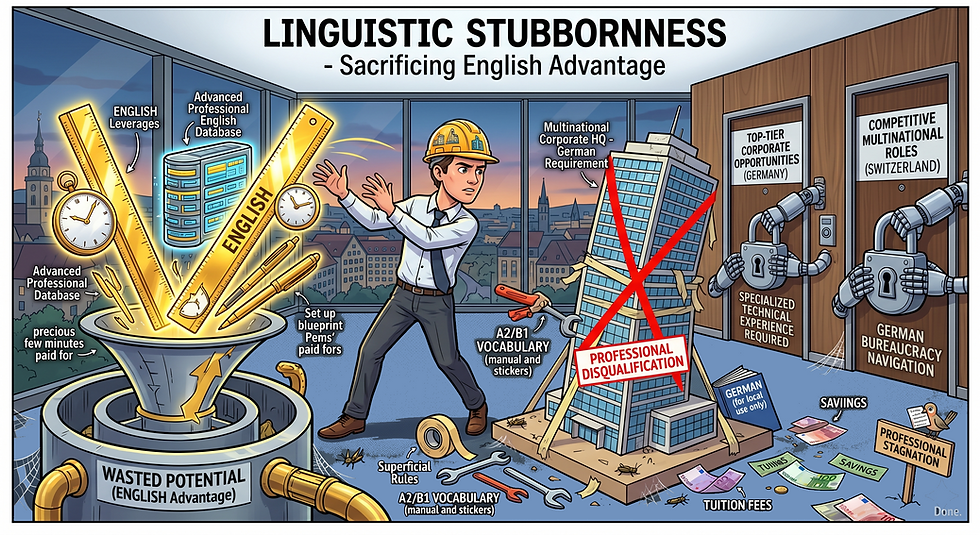
7. Linguistic Stubbornness: Sacrificing English Advantage
An ideological trap that many enthusiastic learners fall into is the absolute elimination of English. Driven by an obsessive desire to sound like German from a native, they completely stop speaking, reading, or maintaining English, believing that total mono-focused isolation is the only path to true cultural integration.
This is an act of clear professional self-sabotage.
In the modern globalized economy, your English proficiency is a massive competitive leverage point. The highest-paying corporate positions, particularly within multinational conglomerates or when targeting elite jobs in Switzerland, require a flawless command of English alongside a simple A2 or B1 professional-grade German.
If you stubbornly suppress your English capabilities, you disqualify yourself from top-tier corporate positions and effectively lock yourself into mid-level, purely localized roles, which you may have hard time getting, since for those jobs it is required these days a minimum level of C2! If you don't believe me, just look it up!
8. The "Language as a Job Ticket" Myth
Perhaps the most widespread delusion among international applicants is learning the language solely under the assumption that it acts as a guaranteed ticket to corporate employment. They spend thousands of hours studying, thinking that once they reach a certain level, human resource managers will automatically line up to offer them competitive roles. Maybe that's the case in the 90s back in Germany...
But right now, sorry to be the bearer of bad news here, but let's clarify this direct economic reality: language is merely a communication medium; it is not a core professional skill.
If you do not possess a highly marketable technical, medical, scientific, or financial skillset, knowing German simply means you can now compete for entry-level, low-wage customer service or administrative roles against millions of native speakers who naturally understand the cultural nuances far better than you.
German magnifies existing professional value, however it does not create value out of thin air.

9. Ignoring Grammar and Using Literal Translations
If you wish to remain completely incomprehensible to any native speaker, you should absolutely ignore German grammar rules and rely on 1-to-1 literal translations from your native language. Many casual learners try to force English syntax directly onto German vocabulary because they want to believe they can find an easy way out of rigorous study.
However, German is a highly structured language with rigid architectural constraints.
The verb-second rule, the mandatory placement of infinitive or past-participle verbs at the absolute end of subordinate clauses, and the precise application of the four grammatical cases are non-negotiable structural elements.
When you speak German using English grammatical frameworks, you do not just sound informal, you disrupt the logical flow of the language, rendering your speech a frustrating puzzle for native speakers to decode.
Just to give an example here:
Imagine trying to explain a change in your schedule.
The English Mental Blueprint: "I have to cancel the meeting today because I forgot my laptop at home."
The Literal English-to-German Translation: "Ich muss absagen das Meeting heute, weil ich vergaß meinen Laptop zu Hause."
To a native German speaker, this structural breakdown is painful. By placing the infinitive verb (absagen) too early and failing to send the second verb (vergaß) to the absolute end of the subordinating weil clause, you have shattered the natural cadence of their language.
Instead of processing your thought smoothly, the native speaker's brain must actively pause, gather the floating pieces of your sentence, and manually reconstruct them into the correct grammatical framework:
"Ich muss das Meeting heute absagen, weil ich meinen Laptop zu Hause vergessen habe."
When you refuse to shift your internal gears from English syntax to German structure, you turn a simple conversation into an intellectual chore. You force the listener to do the heavy lifting of rearranging your vocabulary just to figure out what actually happened. Grammatical fluidity isn't just about sounding polished—it's about removing the friction of communication.
10. The "Better Life" Delusion vs. Socio-Economic Realities
The final and most profound trap is the existential expectation that mastering German will automatically grant you a flawless, stress-free "better life" in Western Europe. Unless you are migrating from a severely unstable or conflict-torn third-world nation, the socio-economic realities of living in the region can be an intense psychological shock to unprepared professionals.
Once you achieve the language proficiency required to look past the surface-level tourism, you are met with aggressive progressive taxation structures that heavily cut into your nominal income, a deeply institutionalized and rigid bureaucracy that moves at an incredibly slow pace, and an intrinsically reserved social culture where forming deep, authentic friendships can take years.
If you uproot your entire life and endure the immense cognitive strain of mastering German solely based on an idealized vision of European life, you risk facing deep emotional isolation.
If you have read this far and are deterred by the harsh realities outlined above, then this warning has served its purpose. However, if you are a pragmatic realist who understands that true professional advancement requires systemic discipline, then you must adjust your strategy immediately. Stop looking for shortcuts, abandon the chaotic reliance on gamified mobile applications ONLY, and stop expecting the language to save a lack of concrete professional skills.
Yes, they do help you to develop your German, but they shouldn't be the only way forward.
To succeed, you must approach your study with the mindset of an engineer analyzing a complex structural system. Build a dedicated, daily habit focused on rigorous grammatical accuracy. Combine your linguistic progression with highly specialized technical or professional skills, and view the language as a powerful operational tool rather than a magical solution. Only by acknowledging that the journey is difficult can you realistically position yourself to exploit the genuine, high-value economic opportunities available within the European corporate landscape.
If you're looking to learn German with a structure than check-out this blog here that discusses on mastering German properly via AI: https://www.learngermanlikenatives.com/post/12-months-ai-structured-german-course-to-speak-german-fluent
And for a tutor who understands well on these situation and teach students to application, click here and try out a trial lesson today!: https://preply.com/en/tutor/2318126


Comments