


10 Must-Try Dishes under DACH Region (Germany, Austria, Switzerland)
The geographic heart of Central Europe is home to a rich tapestry of flavors, deeply intertwined with the historic landscapes of Germany, Austria, and Switzerland. Collectively known as the DACH region, this area boasts a fascinating cross-pollination of culinary techniques, where German culture, Swiss culture, and Austrian culture shape everyday dining experiences. To uncover the absolute highlights of this culinary wonderland, a comprehensive scan of the digital landscape—from search volume statistics and travel forum recommendations to social media engagement metrics—reveals the top ten most highly recommended dishes across the internet.
By evaluating global digital interest, this report presents a ranked guide to these culinary treasures, exploring the elements that make them unique, the specific establishments where they are served at their absolute best, and the pricing structures travelers can expect to pay. For anyone eager to explore the best German food, best Swiss food, and best Austrian food, this list offers the ultimate starting point for a delicious journey.
The Global Search Hierarchy of Central European Classics
The online popularity of these ten dishes is presented in the structured overview below, ranked by their global digital search intensity and transaction volume across delivery and travel platforms.
Rank | English & Regional Names | Primary Origin | Search Intensity Tier | Key Local Establishments | Estimated Price Range (2025/2026) |
1 | Wiener Schnitzel | Austria | Extreme | Figlmüller Bäckerstraße, Plachutta (Vienna) | €21.70 – €35.50 (Veal) |
2 | Cheese Fondue (Käsefondue) | Switzerland | Extreme | Saycheese (Zermatt), Fribourger Fonduestübli (Zurich) | CHF 25 – CHF 50 per person |
3 | Currywurst | Germany | Very High | Curry 36, Curry 61, Curry Baude (Berlin) | €4.00 – €5.00 per portion |
4 | Raclette | Switzerland | Very High | Swiss Chuchi (Zurich), Valais Alpine Huts | CHF 25 – CHF 60 per portion |
5 | Apple Strudel (Apfelstrudel) | Austria | High | Demel, Café Central, Café Mozart (Vienna) | €4.00 – €10.00 per slice |
6 | Potato Rösti (Rösti) | Switzerland | High | Zeughauskeller (Zurich), Bernese Beizli | CHF 15 – CHF 28 per serving |
7 | Cheese Spätzle (Käsespätzle) | Germany / Austria | High | Hofbräuhaus (Munich), Tyrolean Alpine Huts | €12.00 – €16.00 per plate |
8 | Roasted Pork Knuckle (Schweinshaxe) | Germany | High | Hofbräuhaus, Wirtshaus Ayingers (Munich) | €19.50 – €28.30 per portion |
9 | Sour Roast (Sauerbraten) | Germany | Medium-High | Traditional Gastenhäuser (Rhineland & Franconia) | €18.00 – €25.00 per serving |
10 | Sacher Cake (Sachertorte) | Austria | Medium-High | Hotel Sacher, Café Demel (Vienna & Salzburg) | €8.00 – €10.00 per slice |
Deep Culinary Analysis of the 10 Must-Try Dishes
1. Wiener Schnitzel
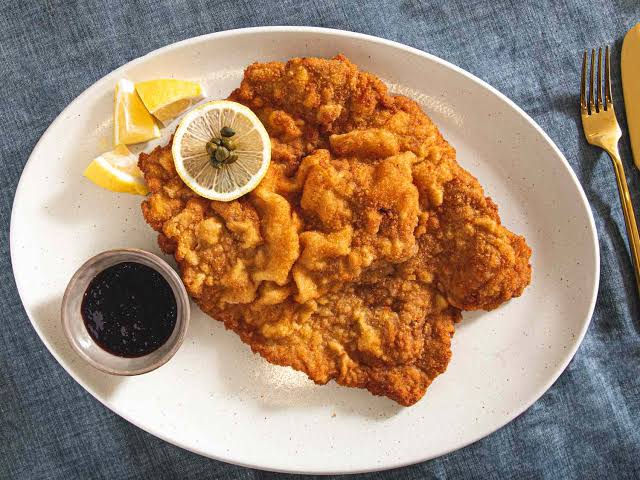
When discussing Austrian food names, none carry the global prestige of the Wiener Schnitzel. The legal regulations surrounding this dish reflect the pride of Austrian culture; it can only bear the name Wiener Schnitzel if it is prepared using high-quality veal. Pork variants must be menu-labeled as "Schnitzel Wiener Art".
The uniqueness of a true Wiener Schnitzel lies in its meticulously crafted "soufflé" crust. Veal topside is pounded incredibly thin, dredged in flour, egg, and breadcrumbs, and then pan-fried in clarified butter or lard. The pan is constantly agitated, allowing steam to pocket between the meat and the breading, creating an airy, golden wrapper. Though deeply woven into the identity of Austria, historical evidence suggest its roots trace back to Venice, arriving in Vienna around 1857 under Field Marshal Count Radetzky.
Travelers looking for the ultimate schnitzel experience will find long lines at Vienna’s legendary Figlmüller, where the classic veal version on Bäckerstraße is priced around €28.90. For a more refined, upscale dinner, Plachutta Wollzeile serves a technically perfect schnitzel for approximately €21.70 to €32.00. For those on a budget, Schnitzelwirt in the 7th district offers massive, honest pork-style schnitzels for a modest €8.10. This crispy masterpiece is universally praised as the best Austrian food.
2. Cheese Fondue (Käsefondue)

A bubbling ceramic pot of Cheese Fondue is the quintessential image of winter hospitality, making it the most famous among Swiss food names. Developed centuries ago as an inventive way for Alpine peasants to utilize hardened winter cheese and stale bread, it has grown into a major social phenomenon. The classic "moitié-moitié" (half-and-half) preparation features equal parts Gruyère and Vacherin Fribourgeois cheeses, melted slowly in a dry white wine base with garlic, cornstarch, and a splash of cherry schnapps, known as Kirsch.
Online search volume for fondue remains consistently elevated, driven by its festive, social nature, which is celebrated across Instagram with over a million dedicated hashtags. Swiss culture has birthed a playful dining etiquette around the communal pot, known as a caquelon. According to tradition, if a gentleman drops his bread into the cheese, he must buy a round of drinks for the table, whereas a lady who does the same must kiss her neighbors.
For the most authentic dining experience, travelers head to specialized Swiss venues like Fribourger Fonduestübli in Zurich or the highly rated Saycheese at the Grand Hotel Zermatterhof in Zermatt, where classic fondues range from CHF 28 to CHF 36 per person. The average restaurant cost across mid-range Swiss establishments is typically between CHF 35 and CHF 50 per person, representing the very pinnacle of the best Swiss food.
3. Currywurst

A fascinating contrast to the refined pastries of Vienna, the humble Currywurst is the undisputed champion of the best German food in the casual dining sector. Born in post-war Berlin in 1949, it was invented by Herta Heuwer, a resourceful housewife who mixed ketchup, Worcestershire sauce, and curry powder obtained from British soldiers, slathering the concoction over grilled pork sausage to feed construction workers. The dish represents a proletarian culinary symbol within German culture, conventionally served on a simple cardboard tray with a tiny wooden fork.
The global fascination with Currywurst is immense; even the automotive giant Volkswagen has produced its own branded currywurst sausage (part number 199 398 500 A) at its Wolfsburg headquarters since 1973, selling an astounding 8.55 million units in 2024 alone.
Berlin is the ultimate pilgrimage site for Currywurst enthusiasts. Kiosks like Curry 36 Mehringdamm and Curry 61 near Hackescher Markt are constantly bustling with locals, students, and tourists. A classic currywurst, either "mit Darm" (with casing) or "ohne Darm" (without casing), is incredibly budget-friendly at €4.00 per sausage, while a side of crispy fries, requested "rot-weiss" (red ketchup and white mayonnaise), costs €3.80.
4. Raclette

Another jewel of Swiss culture, Raclette is both a semi-hard cow’s milk cheese and a theatrical dining method. The name derives from the French word "racler," meaning "to scrape". Originating with Swiss mountain shepherds who gathered around campfires, the process involves heating a wheel of cheese until it bubbles and then scraping the golden, molten layer onto boiled jacket potatoes, pickled cocktail gherkins, and pearl onions.
Digital interest in Raclette has surged in recent years, propelled by the visual nature of food-centric social media. The aesthetic of gooey, bubbling cheese cascading over potatoes has made it a viral sensation, with nearly half a million posts on Instagram and a high search affinity among luxury foodies.
While readily available in alpine chalets across the canton of Valais, travelers visiting major cities can enjoy authentic preparations at Swiss Chuchi in Zurich or Château de Villa in Sierre. A standard single-serving portion of melted raclette typically costs CHF 25 to CHF 35, while a full, multi-course dining experience at mid-range urban restaurants ranges from CHF 40 to CHF 60.
5. Apple Strudel (Apfelstrudel)

As a sweet masterpiece deeply rooted in the history of the Habsburg Empire, the Apfelstrudel is highly searched by those looking to experience traditional Austrian baking. The pastry is closely related to Turkish baklava, with its name translating to "whirlpool" in German. Its unique preparation relies on a delicate, elastic, unleavened dough that must be stretched by hand until it is paper-thin. Historically, bakers said the dough was perfect only when one could read a newspaper through it. This dough is wrapped around a sweet, spiced filling of apples, sugar, cinnamon, raisins, and butter-fried breadcrumbs.
To experience a classic strudel alongside a cup of Viennese Melange coffee, travelers queue at Kohlmarkt 14 in the heart of Vienna for Café Demel. Demel’s master bakers prepare these treats behind glass walls for patrons to admire.
At historic establishments like Demel or Café Central, a single portion costs between €6.00 and €10.00, while neighborhood konditoreien across Vienna offer excellent, fresh versions for a more modest local price of €4.00 to €6.00.
6. Potato Rösti (Rösti)

Rösti is a crispy, golden potato pancake that has transitioned from a humble morning meal for Bernese farmers into a national treasure of Switzerland. Coarsely grated raw or parboiled potatoes are seasoned and pan-fried in hot butter or lard until they form a flat, compact cake with a highly textured crust. The significance of the dish is so profound that it defines the cultural and linguistic boundary between the German- and French-speaking cantons of Switzerland, affectionately termed the "Röstigraben".
Locals frequently enjoy luxurious variations such as Rösti Valaisanne, which is topped with salty bacon, a fried egg, and a blanket of melted raclette cheese.
For travelers looking to sample this classic Swiss potato specialty, Zeughauskeller in Zurich is highly recommended, serving it alongside traditional sliced meats. Expect to pay around CHF 15 to CHF 20 for basic preparations, with fully loaded restaurant versions ranging from CHF 18 to CHF 28. For home cooking, Migros pre-packaged portions are a staple of Swiss pantry life, retailing for a convenient SFr. 4.95.
7. Cheese Spätzle (Käsespätzle)

Shared across the southern borders of Germany and the alpine valleys of Austria, Käsespätzle is a beloved dish that bridges German food names and Austrian food names. Often compared to an alpine version of macaroni and cheese, the dish consists of fresh, hand-pressed egg noodles (Spätzle) layered alternately with strong local cheeses—such as Bergkäse, Graukäse, or Emmentaler, and topped with crispy, butter-caramelized onions.
The dish is incredibly popular on travel forums as the ultimate comfort food after a long day of hiking or skiing in the Alps. It is commonly served in a rustic cast-iron pan alongside a fresh green salad to cut through the rich, cheesy layers.
For an authentic taste of this comforting staple, the historic Hofbräuhaus in Munich serves a generous, steaming plate of Käsespätzle with braised onions for €15.50. Traditional mountain huts in Tyrol and Vorarlberg price this satisfying meal between €12.00 and €16.00, making it one of the most accessible and comforting dishes in the region.
8. Roasted Pork Knuckle (Schweinshaxe)

No exploration of Bavarian culinary pride is complete without the Schweinshaxe, a dish that commands high search volumes around the autumn Oktoberfest season. This roasted pork knuckle is a southern German classic, easily distinguished from its northern cousin, the boiled and cured "Eisbein". The lower part of the ham hock is marinated with caraway, garlic, and beer, then slow-roasted in the oven until the skin puffs into a salty, shatteringly crisp crackling, while the meat remains tender and juicy.
Munich's historic Altstadt is the global capital of Schweinshaxe consumption. At the famous Hofbräuhaus at Platzl 9, a whole roasted pork knuckle, drenched in a rich dark beer sauce and accompanied by a dense potato dumpling, is priced at €19.50.
During the annual Oktoberfest celebrations, the major beer tents, such as the Hofbräuhaus-Festzelt and the Haxnbraterei, serve this massive delicacy for €27.00 to €28.30 per portion. Because the portions are exceptionally generous, a single knuckle is often shared between two diners.
9. Sour Roast (Sauerbraten)
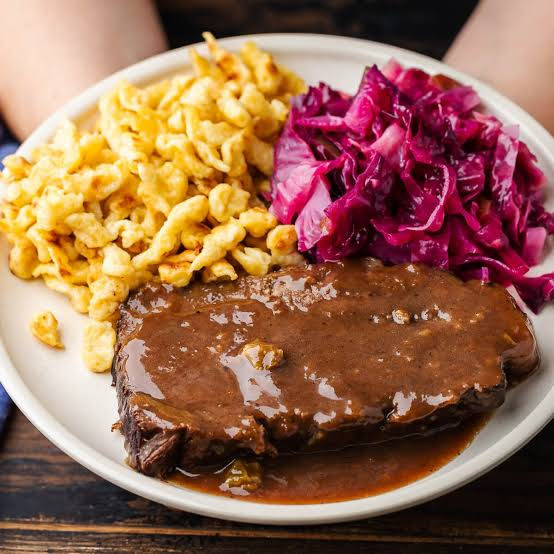
Frequently regarded as the national dish of Germany, Sauerbraten is a testament to the slow-cooking traditions of the region. Its origins date back to medieval times, when marinating beef in a sour-sweet vinegar and wine mixture for three to ten days was a necessity to preserve and tenderize tough cuts of meat. Once marinated, the meat is slowly braised, and the roasting juices are reduced with spices to create a sweet and sour gravy.
Sauerbraten is highly searched by home cooks fascinated by its multi-day preparation process. Regional differences are a source of great culinary pride; Rhineland Sauerbraten is sweetened with raisins and gingerbread, Swabian style features no sweetening, and
Franconian recipes are thickened with ginger Lebkuchen cookies.
Diners can experience this classic roast in traditional German restaurants throughout the Rhineland and Bavaria, where a complete plate, typically served with red cabbage and potato dumplings, costs between €18.00 and €25.00.
10. Sacher Cake (Sachertorte)

Sachertorte is perhaps the most famous chocolate cake in the world, serving as a sweet icon of Austrian culture. Invented in 1832 by a 16-year-old kitchen apprentice named Franz Sacher to impress Prince Metternich, the cake is characterized by its elegant simplicity: a dense, dark chocolate sponge cake, a thin layer of tart apricot jam, and a glossy dark chocolate icing.
The cake’s internet fame is boosted by its historic and legal drama. A decades-long court battle between the Hotel Sacher and Café Demel over the right to use the title "The Original Sachertorte" resulted in a compromise: Hotel Sacher’s version features two layers of apricot jam (one in the middle and one under the glaze), while Demel’s version features a single layer directly under the icing.
A single slice served with unsweetened whipped cream (Schlagobers) is priced between €8.00 and €10.00 at Café Sacher or Demel. For travelers looking to take a piece of Vienna home, Demel sells whole, beautifully packaged cakes in signature wooden boxes with golden corners, ranging from €18.00 to €51.00 depending on the size.
While global search engines and travel platforms are dominated by these ten historic recipes, the dining landscape of Central Europe is undergoing a modern transformation. Domestic meat consumption across Germany has shown a steady decline, falling below 60 kilograms per capita. This shift has driven classic establishments to introduce highly rated plant-based alternatives to satisfy a new generation of diners.
For instance, Vienna’s historic Figlmüller has successfully introduced a vegan schnitzel made of pea and sunflower protein for €22.90, which has quickly become a favorite among local vegetarian diners. Similarly, Berlin's famous Curry 36 has expanded its menu to feature a soy-protein vegan currywurst for €5.00, proving that even the most deeply rooted street-food traditions can adapt to modern lifestyles.
This blend of preservation and modern inclusion ensures that the best German food, best Swiss food, and best Austrian food remain globally competitive and highly relevant for decades to come.


Comments