


Prepositions that may end up looking the same in English but it's not
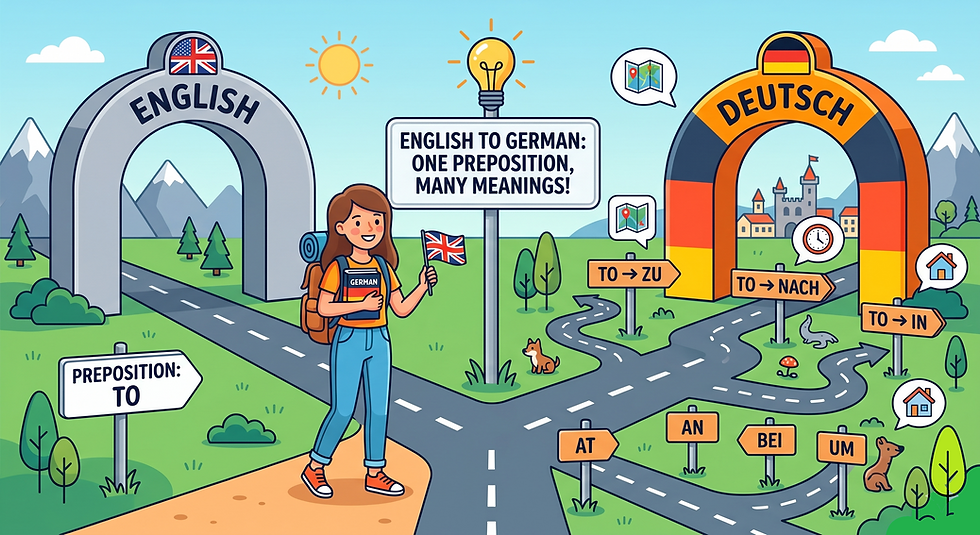
Let’s be honest for a second. We’ve all heard the persistent rumor: German is hard. And while there are definitely some tricky grammar rules, three distinct genders to memorize, and incredibly long compound words that look like a cat simply walked across a keyboard, conquering this language doesn't have to be a nightmare. In fact, if you want to learn German fast, one of the absolute biggest hurdles you will need to overcome is figuring out how to properly use German prepositions.
Why do prepositions cause so much grief for beginners and intermediate learners alike? It mostly comes down to how our brains are wired. As language learners, we naturally try to translate directly from our mother tongue. You think to yourself, "Okay, the English word is 'to', so I just need to open my dictionary, find the German word for 'to', and use it everywhere!"
Unfortunately, that is a massive trap. Prepositions simply do not map on a clean, one-to-one basis between English and German. A single English preposition can translate into three, four, or even five different German ones, depending entirely on the context, the physical space, and the grammatical case. If you truly want to learn German like natives, you have to stop translating word-for-word in your head and start thinking about the actual context of the situation.
1) The "To" Trouble (Zu, Nach, In)

One of the most common questions from beginners trying to figure out how to learn German prepositions is a seemingly simple one: "How do I say 'to'?" In English, we use "to" as a universal tool. We go to the grocery store, to Germany, to our friend's house, and to bed. We use it for almost any kind of movement toward a destination.
In German, however, you have to be much more specific about where exactly you are going.
Nach: You use nach when you are traveling to a geographical destination that doesn't use a definite article. This means the vast majority of cities, countries, and continents.
Example: Ich fliege nach Berlin. (I am flying to Berlin.)
Example: Wir fahren nach Italien. (We are driving to Italy.)
Exception to remember: If the country does have an article (like die Schweiz / Switzerland or die USA), you don't use nach. Which brings us to the next point.
In: You use in (typically paired with the accusative case to show movement) when you are going into an enclosed space, a specific building, or a country with an article. You aren't just traveling toward it; you are entering it.
Example: Ich gehe in den Supermarkt. (I am going to the supermarket - literally, into the building.)
Example: Wir reisen in die Schweiz. (We are traveling to Switzerland.)
Zu: You use zu when you are going to a person, a specific named business, or a general location without necessarily going inside of it. It implies moving in the direction of a target.
Example: Ich gehe zu meinem Arzt. (I am going to my doctor.)
Example: Wir gehen zum Bahnhof. (We are going to the train station.)
2) The "On" Obstacle (Auf vs. An)

Okay, so you've mastered "to" and are feeling confident. What about "on"? In English, a picture hangs on the wall, and a heavy textbook sits on the table. Easy enough, right?
German forces you to look at the physical geometry of the situation. Is the surface you are talking about horizontal or vertical?
Auf: This preposition is strictly for horizontal surfaces. If something is resting flat on top of something else, you use auf.
Example: Das Buch liegt auf dem Tisch. (The book is lying on the table.)
Example: Der Hund schläft auf dem Boden. (The dog is sleeping on the floor.)
An: This preposition is used for vertical surfaces, or being right at the boundary/edge of something.
Example: Das Bild hängt an der Wand. (The picture is hanging on the wall.)
Example: Wir sitzen am Strand. (We are sitting on the beach - you are at the border of the water and the land.)
Visualizing the physical space is one of the best tips to learn German prepositions you can ever get. Don't just memorize definitions on a flashcard; close your eyes and memorize the physical relationship between the objects.
3) The "At" Attack (Bei, Um, An)
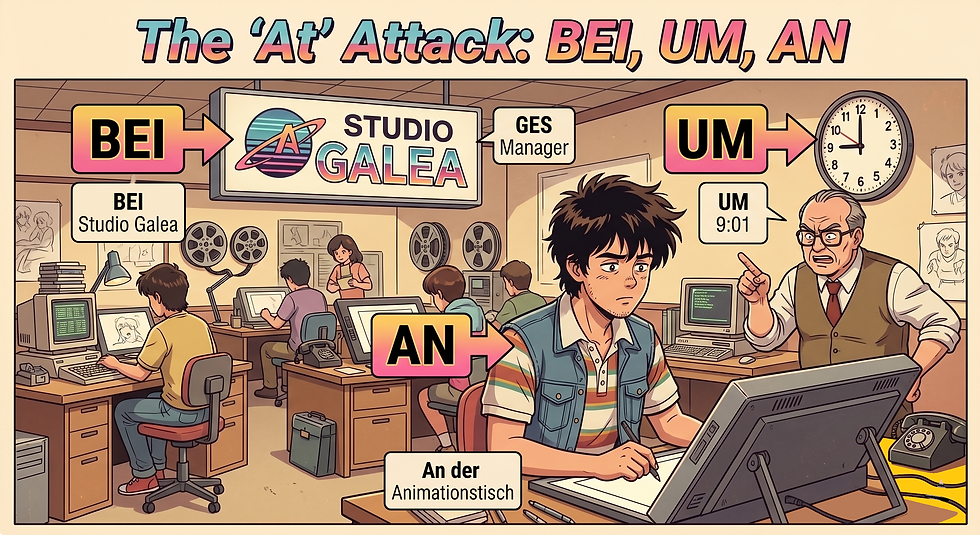
"At" is another huge offender when it comes to translation confusion. In English, you look at the time, you are at work, or you are standing at the door. In German, these all require different words.
Um: If you are talking about a specific time on a clock, "at" is always translated to um. No exceptions!
Example: Das Konzert beginnt um 20 Uhr. (The concert starts at 8 PM.)
Bei: You use bei when you are physically at someone's home, at a company, or near a location. It implies proximity or presence at a professional establishment or gathering.
Example: Ich bin bei meiner Mutter. (I am at my mother's house.)
Example: Er arbeitet bei Siemens. (He works at Siemens.)
An: As we mentioned in the previous section, an is for borders or vertical proximity. So if someone is knocking, they are right up against the vertical frame of the door.
Example: Jemand steht an der Tür. (Someone is standing at the door.)
4) The "For" Frustration (Für vs. Seit)

Let's switch gears and talk about time and purpose. In English, "for" is a massive workhorse. You might say, "I bought this gift for you," and in the next breath say, "I have been living here for three years." To an English speaker, the word "for" seamlessly handles both the intended recipient of an object and a duration of time. German does not allow this shortcut.
Für: This translates directly to the English "for" when you are talking about a recipient, a specific purpose, or an exchange of goods.
Example: Das Geschenk ist für dich. (The gift is for you.)
Example: Ich brauche Zeit für mich. (I need time for myself.)
Seit: This is where English speakers mess up constantly. If you are talking about an action that started in the past and is still ongoing in the present, English uses "for" (to indicate duration) or "since" (to indicate a starting point). German simply uses seit for BOTH situations, and importantly, pairs it with the present tense!
Example: Ich wohne hier seit drei Jahren. (I have lived here for three years.)
Do not say "Ich lebe hier für drei Jahre." That sounds incredibly unnatural to a German ear. To learn German like natives, mastering the use of seit with the present tense to express ongoing time is absolutely non-negotiable.
5) The "By" Bother (Von, Mit, Bis)

Let's look at one last sneaky preposition: "by". You can say the book was written by him. You can say you prefer to travel by train. You can also tell your boss that you will have the report finished by tomorrow. Three different contexts, three different German prepositions.
Von: When indicating the creator, author, or the origin of something (especially when using the passive voice), you use von.
Example: Das Buch wurde von Goethe geschrieben. (The book was written by Goethe.)
Mit: When talking about modes of transportation or the means of doing something, English relies on "by", but German uses mit (which translates literally to "with").
Example: Ich fahre mit dem Zug. (I travel by train / literally: I travel with the train.)
Bis: When referring to a strict deadline in time, use bis.
Example: Ich brauche das Dokument bis Freitag. (I need the document by Friday.)
Let’s face the facts: people often complain that German is hard, and when you first stare down a list of German prepositions, it’s incredibly easy to see why. The grammatical gymnastics required to pick the right word can feel overwhelming. However, a shift in mindset is what you ought to consider. You must stop treating them like simple vocabulary word, as you simply can’t swap an English word for a German one and expect it to make sense 100% of the time.
With enough exposure, patience, and practice, it will eventually click. You will begin to learn German like natives because you'll be naturally thinking in the language itself, rather than acting as a stressed-out human translator inside your own head. So, take a deep breath, utilize these tips to learn German prepositions, and tackle them one context at a time!


Comments