


It's 2026, is it still worth studying or working in Germany?
- Apr 25
- 7 min read
Updated: Jun 15
For decades, Germany has been a magnet for international talent. It was the land of Dichter und Denker (poets and thinkers), the powerhouse of European engineering, and a bastion of economic stability. But time doesn’t stand still.
For decades, the global consensus was simple: if you wanted the pinnacle of engineering, efficiency, and career stability, you went to Germany. This was the nation that pioneered the modern automotive industry, setting the global gold standard with brands like Volkswagen, BMW, and Mercedes-Benz. The world looked to Germany as the "Economic Locomotive" of Europe, a place where Deutsche Gründlichkeit (German thoroughness) meant that systems worked, trains ran on time, and a "job for life" was a reasonable expectation. It was the ultimate first-world career destination—a land where high productivity was balanced by high social security, making it a magnet for the world's brightest minds in STEM and manufacturing.
However, as we navigate 2026, that pristine image is facing a reality check. The digital revolution, a shifting global energy landscape, and aging infrastructure have begun to test the traditional German foundations of efficiency. While the prestige of the "Made in Germany" label still carries weight, the path for a professional in 2026 looks very different than it did for the generations that came before. We are witnessing a transition from a hardware-dominated industrial giant to a nation trying to find its footing in a software-driven, decarbonized world.
You might be sitting there wondering if the "German Dream"—free education, a high standard of living, and abundant job opportunities—is still a reality or just a lingering memory from the 2010s.
Is Germany still a premier destination for pursuing education, launching a career, or making investments? The answer isn't a simple "yes" or "no." It is a nuanced "it depends."
In this post, we’ll break down the current realities of life in Germany in 2026, balancing the significant challenges (Nachteile) against the enduring advantages (Vorteile) to help you decide if this central European giant is still worth your time and energy.

The Current Challenges: Navigating the Nachteile
If you are looking for the Germany of 2015, you won’t find it. Seriously it was some great time back then... By 2026, several structural and social issues have come to the forefront, making the path for internationals more challenging than before.
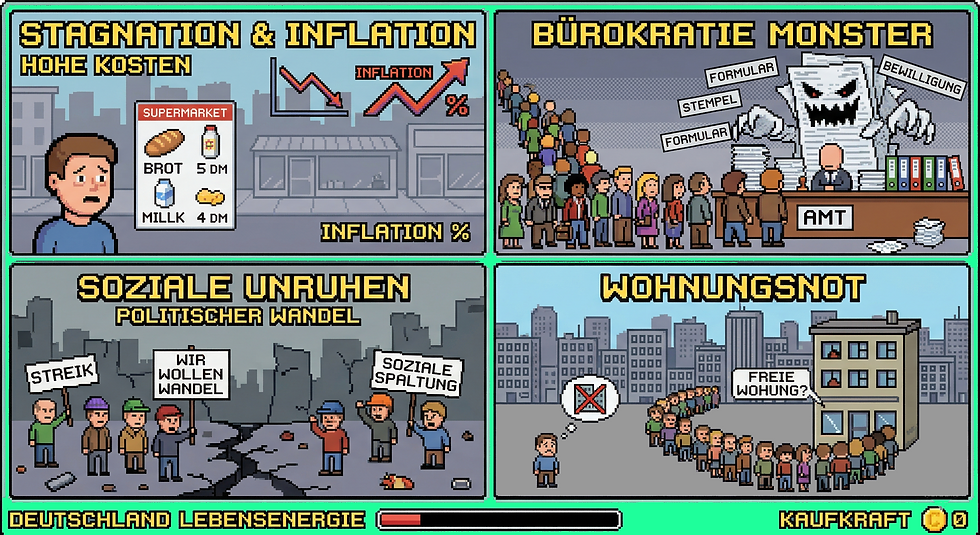
1. Economic Stagnation and Inflation
The "economic engine of Europe" has been idling. Following the energy crises and supply chain shifts of the early 2020s, Germany has struggled to return to robust growth. While not in a full depression, the economy is sluggish. For workers, this means salary growth has not always kept pace with the cost of living, which has risen significantly, particularly in terms of rent and energy.
According to the IMF’s 2026 Article IV Consultation, Germany’s economy has essentially stagnated since 2018. While 2026 shows a projected GDP growth of 1.1% to 1.2%, this follows two consecutive years of contraction and stagnation in 2024 and 2025. (1) And while the hyper-inflation of 2022 (+6.9%) has cooled, prices haven't returned to pre-crisis levels. Destatis reported an average annual inflation rate of 2.2% for 2025, with "core inflation" (excluding volatile food and energy) remaining higher at 2.8%.
2. The Infamous Bureaucracy (Bürokratie)
Despite years of promised "digitalization," German bureaucracy remains legendary—and not in a good way. Whether it’s applying for a visa, registering an address (Anmeldung), or getting a tax ID, you will still encounter mountains of paperwork, required in-person appointments that are hard to book, and a reliance on physical mail. It is a system that can be incredibly frustrating for those used to digital-first government services.
I remember speaking to a Ukrainian woman on how she struggled to get her marriage license in Germany, whereby she has to apply for it using physical papers, and it still took 3 months to process all of her documents, as the German's government administration are always looking forward to just keep processing to "perfection"? Meanwhile, back in her country, the registration, evaluation and generation of all those license are done simply via online and it takes less than a day!
3. Political and Social Shifts
Like much of the world, Germany has seen a rise in political polarization. While it remains a safe, democratic society, there are visible tensions regarding migration and economic policy. For internationals, this can sometimes manifest as a feeling of being less welcome in certain regions, or facing higher hurdles in social integration.
In the most recent federal and state elections, the combined vote share of the traditional mainstream parties fell below 50% for the first time in decades. This vacuum has been filled by a rise in populist parties on both ends of the spectrum, with the AfD and the BSW making record gains in both Eastern and Western states. While Germany remains a safe and robust democracy, this polarization has led to more "social friction" and a noisier public debate regarding migration and economic policy. For internationals, this can manifest as a feeling of being less welcome in certain regions, or facing more complex hurdles in social integration as the political landscape shifts toward more protectionist rhetoric.
4. Housing Shortages
In major cities like Berlin, Munich, Hamburg, and Frankfurt, finding an affordable apartment is a monumental task. The housing supply has not kept up with demand. Even if you land a high-paying job, a large chunk of your salary will go toward rent, and you may face intense competition just to view an apartment.
According to a 2026 forecast by the ifo Institute, the number of completed apartments is expected to fall to just 175,000 units this year, a staggering 40% decline from 2022 levels and less than half of the government's official target of 400,000. High material costs and restrictive interest rates (averaging 3.5% to 4% in early 2026) have caused many developers to stall projects.
What’s Still Standing and Growing: The Vorteile
Despite the heavy challenges, Germany remains a land of immense opportunity. The core reasons people move here have not vanished; in some cases, they have become even more compelling.
1. The Skilled Worker Shortage (Fachkräftemangel) is Acute
This is the biggest driver of opportunity in 2026. Germany’s aging population means it is desperate for workers. If you are skilled in IT (Software Engineering, AI, Data), Healthcare (Doctors, Nurses), or Green Engineering, Germany needs you.
To combat this, the government has streamlined immigration laws. The EU Blue Card thresholds are more accessible, and the "Opportunity Card" (Chancenkarte), a points-based visa for job seekers is fully active, making it easier than ever to enter the country to find work.
2. Education is Still (Mostly) Free and going English
The jewel of the German system remains: public universities offer world-class education with no tuition fees for most programs (you pay a small semester fee of roughly €200-€400, which often includes public transport).
Crucially, by 2026, the number of English-taught programs has grown exponentially. While previously limited to Master’s degrees, many universities now offer Bachelor’s degrees entirely in English, even in the public universities to attract global talent.
Region | Public University | English-Taught Bachelor's Degree Programs |
Berlin | Freie Universität Berlin | • North American Studies (B.A.) • English Language and Literature (B.A.) |
Berlin School of Economics and Law (HWR) | • International Business Management (B.A.) • Business Law (LL.B.) | |
Humboldt-Universität zu Berlin | • American Studies (B.A.) | |
NRW | Rhine-Waal University of Applied Sciences | • International Business (B.A.) • International Relations (B.A.) • Sustainable Tourism (B.A.) • Agribusiness (B.A.) • Bio Science and Health (B.Sc.) • Gender and Diversity (B.A.) |
RWTH Aachen University | • Mechanical Engineering (B.Sc. - International Track) | |
TU Dortmund University | • Applied Literary and Cultural Studies (B.A.) | |
Hamm-Lippstadt University of Applied Sciences | • Electronic Engineering (B.Eng.) | |
Hamburg | University of Hamburg | • English and American Studies (B.A.) |
TU Hamburg (TUHH) | ||
Other Hubs | TU Munich (TUM) | |
University of Göttingen | • Molecular Ecosystem Sciences (B.Sc.) | |
University of Leipzig | • International Physics Studies Program (B.Sc.) |
3. Unbeatable Work-Life Balance and Social Safety Net
Germany continues to offer a quality of life that is hard to match elsewhere. Workers enjoy:
Standard 35-40 hour work weeks.
Mandatory minimum of 20 days of vacation (most companies offer 25-30 days).
Strong robust healthcare system (shared cost between employer and employee).
Excellent public transportation (especially with the permanent establishment of the nationwide "Deutschlandticket").
4. A Hub for Green and High-Tech Investment
While traditional manufacturing has struggled, Germany is investing billions into the green transition and deep tech. If you are interested in renewable energy, electromobility, or AI research, Germany remains a central hub in Europe for innovation and investment.
According to the Federal Ministry of Finance (BMF), Germany has established a Special Fund for Infrastructure and Climate Neutrality slated to run until 2036. For 2026 alone, the government has planned a massive investment of €129 billion, with €58 billion coming directly from this special fund to accelerate climate-neutral industry and digital technology. https://www.bundesfinanzministerium.de/Web/EN/Issues/Public-Finances/SVIK/special-fund-infrastructure-and-climate-neutrality.html

Conclusion: The Verdict
So, is it still worth studying and working in Germany in 2026?
Yes, but you must bring your own "engine."
Germany is no longer a place where you can simply show up and expect everything to fall into place effortlessly. The housing crisis is real, the bureaucracy is tiring, and the economy is not booming.
However, if you are a skilled professional in a high-demand sector (IT, Healthcare, Engineering), or a student looking for elite education without the crushing debt found in the US or UK, Germany is still an exceptional choice. The social safety net, work-life balance, and security remain among the best in the world.
To succeed in 2026, you need two things:
Skills in a demanded niche.
Commitment to learn German. While English jobs exist, true integration and long-term career growth still require the local language.


Comments